Comparing Pool Hashrate With Network Hashrate Growth
Two hashrate numbers decide what a miner earns. The network was running at roughly 950.3 EH/s at a difficulty of 132.76 T, and that figure is the denominator of every earnings estimate. Your pool's hashrate is the sum of the machines plugged into it. At 1000 TH/s you are 1 in 950,300 of the network and you produce 0.00047353 BTC a day, about $40.39 before the listed fee. The two lines grow at different speeds, and only one of them is worth chasing.

Key takeaways
- Share decides money: 1000 TH/s against 950.3 EH/s is 0.00010523% of the network, and that fraction produces 0.00047353 BTC a day whatever the pool's own size.
- Pool growth changes timing, not totals. With 144 blocks found network-wide each day, a pool at 10% of hashrate expects about 14.4 blocks daily, and a pool at 1% expects 1.44.
- The next difficulty step is estimated at +1.90%, which trims per-TH/s output from 0.0000004735 BTC to about 0.0000004647 BTC, or $0.0404 down to $0.0396 a day gross.
- Cadence is a separate choice: PPS+ settles every hour at current difficulty, while PPLNS pays after 6 confirmations over the last 5 difficulty rounds.
Why the two lines move apart
The network line is a measurement of competition. Take the 132.76 T difficulty reading and convert it, and you land near 950.3 EH/s; an independent three-day average of published hashrate came in at 942.8 EH/s, so both methods agree to within about 1%. That global total only shifts when blocks arrive faster or slower than the 144-a-day target, which is why it changes in slow steps rather than continuously.
The pool line is a measurement of participation. A pool's hashrate is the connected hardware, and it can jump in a single afternoon without difficulty moving at all. What changes is the pool's chance of finding the next block. At 450 BTC issued per day across the network, a pool with a tenth of the hashrate should collect roughly 45 BTC of block reward a day on average, and a pool with a hundredth should collect about 4.5 BTC — with plenty of variation around both.
Here is the part that trips people up: none of that alters your expected income. Divide your hashrate by the network's, multiply by 450 BTC and reduce by the fee, and you have your expected daily output regardless of which pool, or how large a pool, you joined. Pool size changes the timing and the spread of credits. It is a cash-flow variable, not a revenue variable.
What changes your own number
Difficulty is the big lever. The next adjustment is estimated at +1.90%, and difficulty moves inversely to per-unit output. Multiply 0.0000004735 BTC per TH/s per day by 1 divided by 1.019 and you get about 0.0000004647 BTC, so the gross rate slips from $0.0404 to roughly $0.0396 per TH/s a day. After the listed 4% fee on the PPS-settled block reward, that is $0.0388 falling to about $0.0381 per TH/s, and a 1000 TH/s fleet moves from $38.77 to about $38.05 a day net.
Uptime is the lever miners actually control. One hour of downtime on 1 PH/s costs about $1.68 of gross income at these readings, which is 0.00001973 BTC, and a full day offline costs the day's $40.39. A fleet that runs at 97% availability for a month loses roughly 22 hours, or about $37 of gross income per PH/s — usually more than any difference between fee tiers on the same hashrate.
The fee tier is the third lever, and it is smaller than most people assume but not trivial. Moving from the listed 4% on the block-reward component to the listed 2% on both components under PPLNS is worth $24.23 a month at 1 PH/s, or $290.76 over a year at a constant difficulty and price. The two components are priced separately, so a 4% and a 2% line never add up to a single blended haircut.
| Hashrate | BTC per day | Gross USD per day | After the listed 4% block-reward fee | Share of the network |
|---|---|---|---|---|
| 100 TH/s | 0.00004735 | $4.04 | $3.88 | 1 in 9.5 million |
| 300 TH/s | 0.00014206 | $12.12 | $11.63 | 1 in 3.2 million |
| 1000 TH/s (1 PH/s) | 0.00047353 | $40.39 | $38.77 | 1 in 950,300 |
| 10,000 TH/s (10 PH/s) | 0.00473529 | $403.89 | $387.74 | 1 in 95,030 |
Read the last column against the fourth. Ten times the hashrate buys ten times the output and a share of the network ten times larger, which is the only relationship in the table that never breaks. Everything else — price, difficulty, fee tier — scales the same line up or down.
Worked example
Take a 1000 TH/s fleet, which is 1 PH/s, and do it line by line at the readings of 22 Sept 2026. Step one, share: 1,000,000,000,000,000 hashes per second divided by 950,300,000,000,000,000,000 gives 0.0000010523, or 0.00010523%. Step two, network issuance: 144 blocks multiplied by the 3.125 BTC subsidy equals 450 BTC a day. Step three, gross output: 450 BTC multiplied by 0.00010523% equals 0.00047353 BTC.
Step four, convert: 0.00047353 BTC at $85,294 is $40.39 a day. Step five, apply the listed fee: 4% off the block-reward component leaves 96%, so the net figure is $38.77, or 0.00045459 BTC. Step six, extend it: 30 days at that rate is 0.014206 BTC, about $1,211.68. Divide the daily figure by 24 for the hourly credit under hourly settlement — 0.00001973 BTC, or $1.68.
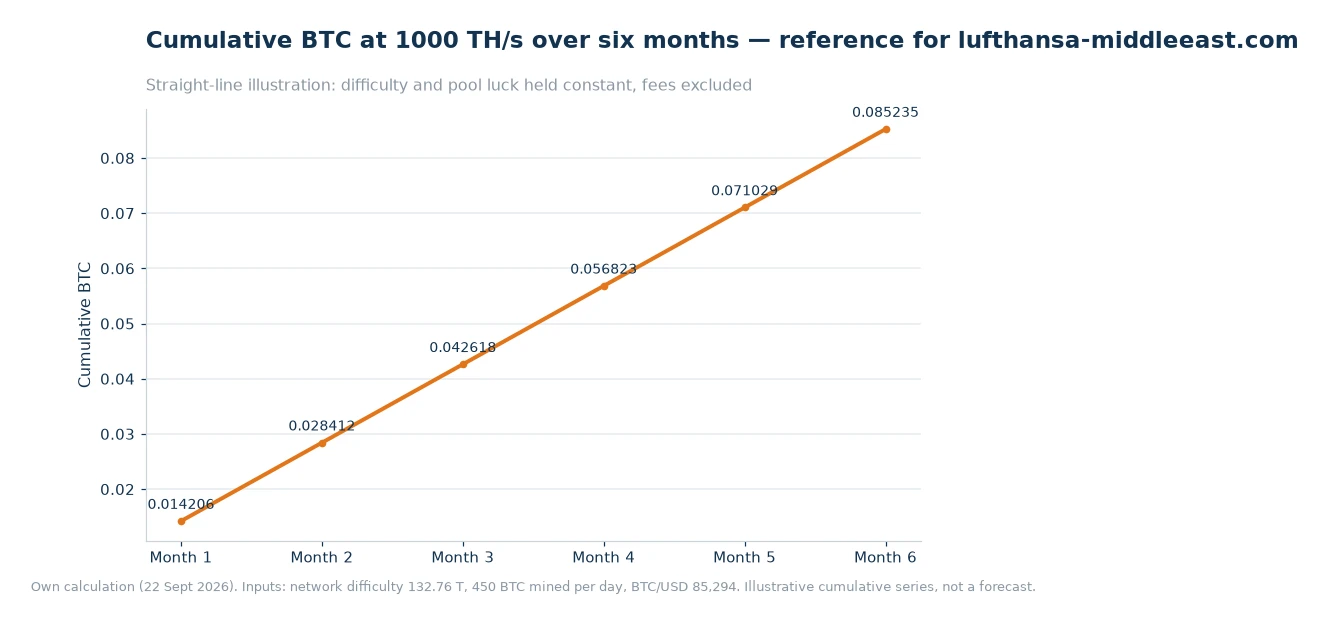
The chart is a straight line because it deliberately freezes the two variables that are never actually frozen. Difficulty has been rising, and the estimated +1.90% step is exactly the kind of change that bends this line downward. Read month six as 0.085235 BTC, roughly $7,270, only if difficulty and price stand still for half a year.
Reading the pool line, not only the network line
Once you accept that pool size is about timing, the dashboard questions get sharper. Watch whether the pool's hashrate is growing while yours is flat, because that quietly shrinks your share of the pool and, under PPLNS, your slice of the 5-round window. Watch Pool Luck as a rolling figure rather than a single day, since a pool that is running behind on expected blocks will show it there before it shows up in your balance.
The public ViaBTC Pool Hashrate view is the fastest way to see the pool line move in real time, and it sits next to the network figure so the two can be compared without switching tabs. Use the pool statistics page for the trends behind it. Then run your own numbers through the Profit Calculator rather than trusting a remembered figure from last month, because difficulty has almost certainly moved since you last looked.
Frequently asked questions
Does joining a bigger pool raise my income per TH/s?
No. Expected income is your share of network hashrate against the 450 BTC issued daily, and a larger pool does not change either term. Pool size changes how evenly blocks land over time and whose shares fall inside the PPLNS window.
How much does a single difficulty adjustment move my daily estimate?
The estimated +1.90% step takes a 1000 TH/s fleet from $40.39 to about $39.64 a day gross, and from $38.77 to roughly $38.05 net. Small per day, but it compounds over months if difficulty keeps climbing.
Which hashrate figures should I track together?
Track the pool's hashrate and luck for payment timing, and the network hashrate for earnings maths. Both come from the same public dashboard, and comparing them weekly is enough for most operators.
What to check each week
Do four things every week and the hashrate comparison stops being abstract. Confirm your own delivered hashrate against the pool figure, so an ailing machine is caught before it costs a full day at $40.39 per PH/s. Note the network hashrate and compare it with the previous week, because three rising weeks usually precede a difficulty step. Check which payout mode you are on and whether hourly settlement still suits your cash flow. Finally, re-run the estimate with today's difficulty and price rather than the numbers from the day you bought the hardware.
Data and sources: ViaBTC listed fee schedule[1] and the public statistics and hashrate dashboards[2]. Difficulty (132.76 T, next step estimated at +1.90%), implied network hashrate (950.3 EH/s), daily issuance (450 BTC) and the BTC price of $85,294 were read from public chain data and market feeds, read 22 Sept 2026. Figures are arithmetic on those inputs, move with difficulty and price, and are not a promise of earnings.