Comparing Acacia, Eucalyptus and Combi Cores for Formwork
Formwork cores are sold three ways — Acacia, Eucalyptus and Combi — and the difference shows up as density, bending resistance and how many pours a sheet survives. Published guidance puts high-grade film faced panels at 10 – 20 reuse cycles, which is a range wide enough that the core choice, not the film, decides where you land.
Key takeaways
- Eucalyptus Core is the density option — high compression resistance and strong bending performance under load.
- Acacia Core trades a little of that density for long service life and load-bearing capacity in repeated pours.
- Combi Core answers the middle of the market: denser and lighter veneers combined so that stiffness, weight and cost stay in balance.
- Reuse is quoted at 10 – 20 cycles for high-grade panels, so core choice is a cost-per-pour decision rather than a ticket price.
What a formwork core is actually doing
A core carries the load between two thin films. When concrete presses on a panel, the core resists compression on the contact side and tension on the reverse, and it holds the screw threads that tie the sheet to the walers. That is why a formwork plywood decision starts with the core rather than with the surface: the film protects the panel, but the core decides whether it stays flat under the pour.
Moisture behaviour follows the same logic. Dense, cross-laminated hardwood layers move less between wetting and drying, and less movement means fewer edge swell complaints after the third or fourth cycle.
Mills that press panels for export tend to publish the whole build-up rather than a single number, and that is how a specification should be read. Take the Film Faced Plywood range as an example: core, glue class, film weight and panel size are listed separately, and each can be matched against a pour type before price enters the conversation.
Acacia, Eucalyptus and Combi side by side
Acacia Core is a high-strength hardwood with excellent density, load-bearing capacity and a long service life. It is the natural choice for panels that will be stripped, cleaned and re-oiled many times. Eucalyptus Core is the denser, stiffer option: maximum strength, high compression resistance and strong bending performance, which suits slabs and walls where deflection is the worry.
Combi Core is the hybrid. The build stacks denser and lighter layers together — Eucalyptus beside Acacia, or a hardwood layer beside a softwood one — keeping stiffness while shedding both weight and cost. On a large shuttering system where operatives lift panels by hand, a Combi panel can be the difference between a comfortable shift and a slow one. White Hardwood Core, built from species such as Bodhi or mixed light hardwoods, sits in the same practical band: stability and balanced mechanical strength at a cost-performance level.
| Core | Strength profile | Where it earns its place |
|---|---|---|
| Acacia Core | Dense hardwood, strong load-bearing capacity | Repeated pours with long service life |
| Eucalyptus Core | High compression resistance, good bending performance | Slabs and walls where deflection matters |
| Combi Core | Eucalyptus + Acacia or hardwood + softwood | Balance of strength, weight and cost |
| White Hardwood Core | Stable, balanced mechanical strength | Cost-effective general shuttering |
Matching glue class and film to the pour
The bonding system decides how the panel behaves when the formwork is wetted. The published classes start at E0, E1 and E2, move up through MR and WBP, and finish with Phenolic Dynea; for concrete contact work the heavier end is what belongs on the order. The surface adds its own variable: a phenolic film at 165 g/㎡ gives a smooth face for fair-faced concrete, and a lighter 130 g/㎡ film is the usual choice where surface finish matters less than handling cost.
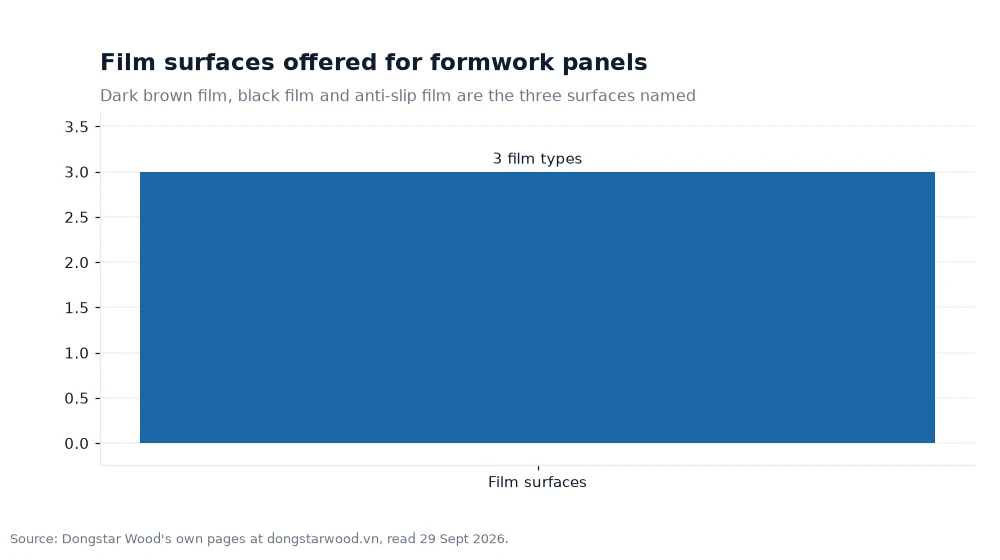
Three surface finishes are named in the range — dark brown film, black film and anti-slip film — so the same core can be delivered with the release behaviour of a smooth sheet or the grip of a textured one. Anti-slip surfaces belong on walkways and platforms rather than on concrete contact faces.
Worked example: cost per pour, not cost per sheet
Take a 1250 × 2500 mm sheet, as an example: 1.25 × 2.5 = 3.125 m² of surface. At the bottom of published guidance, 10 cycles × 3.125 m² = 31.25 m² of contact area from one sheet. At the other end, 20 cycles × 3.125 m² = 62.5 m². Doubling the reuse count halves the sheet cost attributable to each square metre of concrete, which is why a denser core often wins on a project even when it costs more per panel.
Apply the same sum to a small slab package, as an example: 40 sheets × 3.125 m² = 125 m² of formwork area per set, which is a realistic pour face for a low-rise floor. Four such sets reuse the same panels rather than buying four times the stock.
Thickness, edge care and site hygiene
Thickness follows load: 18 mm is the standard recommendation for heavy formwork work and is described as the best overall balance, while 21 mm and above suits bridges and high-load platforms. Sizes run from 1220 × 2440 mm and 1250 × 2500 mm up to 1500 × 3000 mm, with custom panels available to a maximum of 1830 × 3830 mm.
Edge care decides whether a panel reaches the top of its reuse band. Sealed edges, clean stripping, prompt removal of concrete residue and a coat of release agent between pours cost minutes and return cycles. A panel stored face-down in mud loses more service life than one used on a hard slab.
What to confirm before the first formwork set
Four items belong in writing before panels are pressed: core species, thickness, glue class and film type, each tied to the load case it serves. Add the panel size and the quantity per set, because a shuttering system is planned in complete sets rather than in loose sheets, and a shortfall of six panels stops a pour as effectively as a shortfall of sixty.
Ask how edges are sealed and how the panels are packed for the trip, since a stack that shifts in transit arrives with bruised film and catches concrete from the first use. Where the same panels will be used for several floors, agree the cleaning and re-oiling routine with the site team at the same time as the order, so that the panels are not the only part of the system prepared for reuse.
Frequently asked questions
Which core is best for bridge deck and heavy slab work?
Eucalyptus Core is the usual answer where stiffness under load is the controlling factor, specified at 21 mm and above. Acacia Core also performs well when the project needs repeated stripping over a long period rather than maximum stiffness in a single pour.
Does the film weight change the concrete finish?
It does. A heavier 165 g/㎡ film gives the smoother contact face normally wanted for fair-faced concrete, while a 130 g/㎡ film is the practical option where a standard finish is acceptable and lighter handling suits the site.
How should panels be stored between pours?
Flat, on bearers, off the ground and out of standing water. Clean the faces before stacking so set concrete does not bruise the film, keep the edges sealed, and re-oil before the next pour. Storage discipline is usually what separates a ten-cycle panel from a twenty-cycle one.
Choosing a specification you can repeat
Work down from the load case rather than up from the price: fix thickness and core first, then glue class, then film. Buyers who want the surface detail can compare the textured grip-surface panels against smooth faces for the same core, and the economical side of the range is covered by black film panels with an acacia core where the pour count is lower.
Core, film and reuse figures in this comparison are taken from that that the supplier's own pages, checked on 29 September 2026 as the source for this article as the source for this article as the basis for this guide[1].