What Buyers Should Know About Conducting a factory inspection in China
A factory inspection is most useful when its purpose, access, evidence, and reporting criteria are agreed before the visit. Buyers can then distinguish direct observations from claims and connect findings to a clear supplier or order decision.
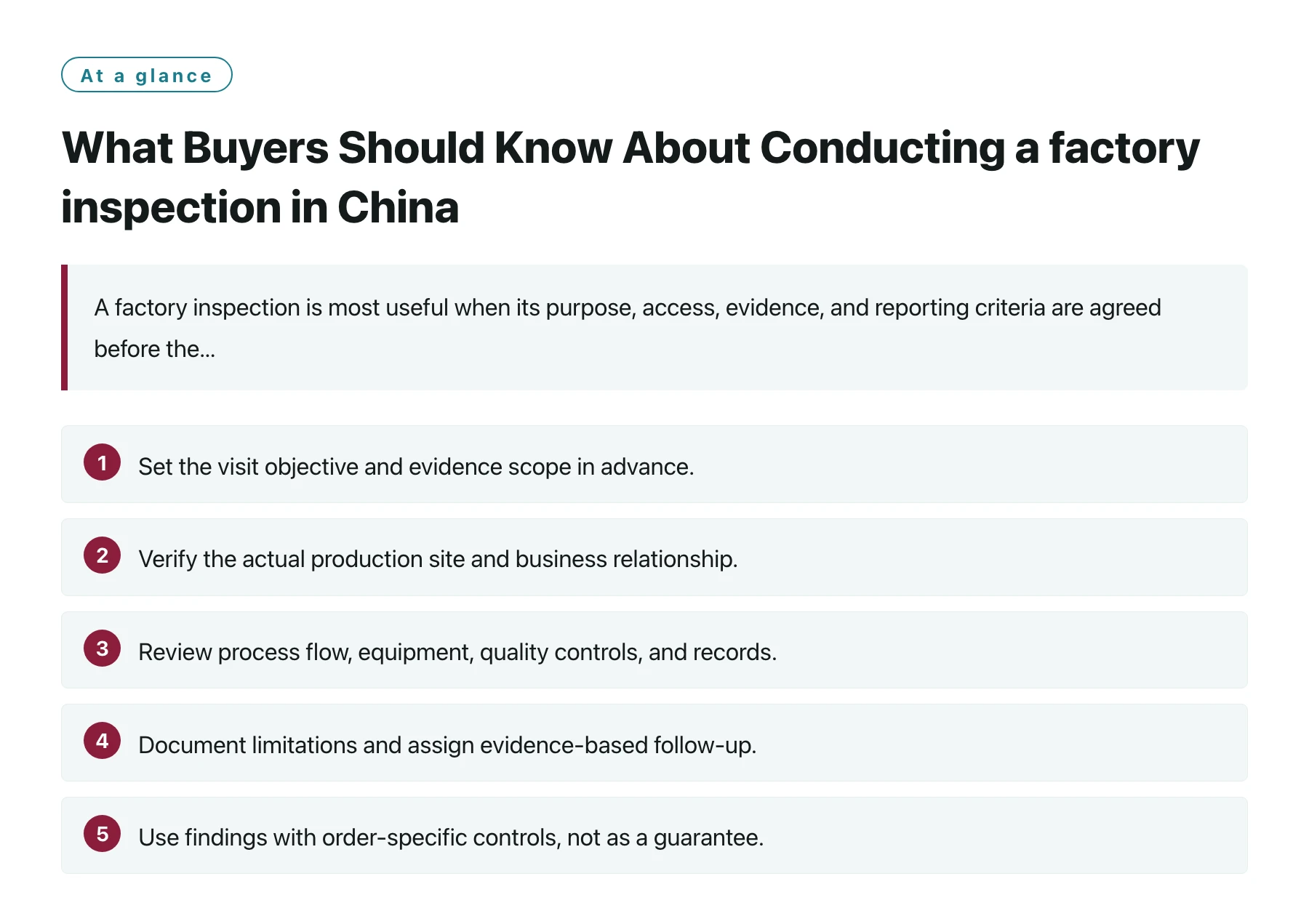
Key takeaways
- Set the visit objective and evidence scope in advance.
- Verify the actual production site and business relationship.
- Review process flow, equipment, quality controls, and records.
- Document limitations and assign evidence-based follow-up.
- Use findings with order-specific controls, not as a guarantee.
A focused visit produces more decision value than a general tour. Its report should show what was observed, what was reviewed, and what remains unknown.
1. Decide what the visit needs to establish
A factory inspection can answer specific questions about identity, facilities, processes, quality controls, capacity, and order readiness. It cannot prove every future shipment will conform. Write the visit objective first: initial supplier screening, production readiness, process review, corrective-action follow-up, or a focused check before placing an order.
Translate the objective into evidence requests and review criteria. A broad instruction to “inspect the factory” leaves the visitor without a consistent basis for judging what matters. Identify high-risk product characteristics, buyer commitments, timeline, and decisions that depend on the findings.
2. Verify the site and business relationship
Confirm the facility address, legal entity, production role, and relationship between the factory, exporter, and contracting party. Ask which building and production line will make the product and whether any operations are subcontracted. Compare the answer with registration information, quotation details, invoices, and the supplier’s website.
The U.S. Department of Commerce recommends due diligence when evaluating foreign business partners. Verify material identity and payment details through independently confirmed channels, and record what source supports each finding. A factory visit is one check in a broader review, not a guarantee of financial stability or performance. [1]
3. Plan access, people, and boundaries
Agree date, facility areas, safety induction, photography, protective equipment, escorts, translator, and contact person. Confirm whether production will be running and which records can be reviewed. Ask about restricted areas in advance so the visit plan reflects actual access rather than assuming every process will be visible.
Identify interview roles: management, production, quality, engineering, warehouse, and customer service as relevant. Where possible, speak with process owners as well as the sales contact. Keep questions tied to the objective and avoid requesting proprietary details that are not needed to judge capability or controls.
4. Walk the process from inputs to finished goods
Map how materials arrive, are identified, stored, issued, processed, inspected, packed, and released. Observe whether lots remain traceable and whether status labels distinguish accepted, held, and rejected material. Compare the actual flow with the supplier’s process description and note where work moves between buildings or subcontractors.
For each important control point, ask who performs it, what instruction is used, what record is created, and what happens when a result fails. A tidy production floor is not itself evidence of a controlled process. Look for consistent practices during normal work and dated records that connect the observation to recent orders.
5. Review equipment, maintenance, and capacity claims
List the equipment relevant to the product and observe condition, setup, tooling, calibration status where measurement matters, maintenance records, and operator assignment. Ask how breakdowns affect schedule and whether critical equipment has backup. Record model or capacity details only where they influence the buyer’s specification.
Test capacity claims against demonstrated process steps, shifts, bottlenecks, current workload, and planned maintenance. Ask how the supplier handles peak demand and urgent changes. A machine’s rated output is not the same as the facility’s available capacity for this buyer’s configuration and quality requirements.
6. Examine quality controls and records
Review incoming inspection, in-process checks, final inspection, measuring equipment, nonconforming product segregation, corrective action, and complaint records. Select a recent example and trace it from the requirement to measurement, disposition, and closure. Redact other customers’ confidential details while preserving dates and process evidence.
Check whether acceptance criteria are specific and available at the work station. Ask how operators receive updated instructions and how superseded versions are removed. If a supplier depends on a subcontractor or laboratory, identify how results are reviewed and how issues are escalated back to the responsible facility.
7. Check production planning and order controls
Ask how purchase orders become production instructions, how specifications and approved samples are controlled, and how changes reach purchasing, engineering, and the line. Review a sample traveler or production record to see whether it names product revision, quantity, process stage, inspection status, and responsible owner.
Compare current workload, staffing, material availability, and promised dates with the buyer’s order assumptions. Identify which statements are confirmed by records and which are forecasts. If the product is not yet in production, state that the visit reviewed readiness and did not observe the actual order run.
8. Review storage, packing, and shipment handoffs
Observe finished-goods identification, protection from moisture or damage where relevant, inventory segregation, packing instructions, carton marks, and staging controls. Check that approved artwork and packing revisions can be traced to the order. Ask who verifies quantity and destination labels before loading.
Discuss loading, container checks, seal records, documents, and handover responsibilities only to the extent included in the assignment. Identify logistics tasks that belong to the buyer or freight provider. A facility visit may show preparation practices but does not by itself verify every carton or destination requirement.
9. Record findings with evidence and limitations
For each finding, write the criterion, observed condition, evidence reference, risk or impact, and follow-up action. Distinguish observation, document review, interview statement, and inference. Include visit date, areas accessed, people interviewed, records sampled, and any limitation such as production not running or key documents unavailable.
Classify issues by practical priority and assign owner and due date. Avoid using an unsupported overall rating to hide a serious open item. If the report says a control exists, cite the record or observation that supports it. Invite factual corrections while retaining the original finding and a documented resolution.
10. Connect the visit to a purchase decision
Use the report with quotation comparison, sample approval, test evidence, references, and contractual controls. Decide whether gaps require closure before order, a corrective-action plan, independent follow-up, or a different supplier. Keep the buyer’s approval authority over supplier appointment, technical acceptance, payment, and production release.
Buyers arranging checking a supplier facility in China can use a written scope to align factory access, records, interviews, and reporting with the decision at hand. Confirm the inspector’s independence, experience, and deliverables; then track each open finding to evidence-based closure.
Sources
Frequently asked questions
What should a factory inspection in China cover?
Set a purpose first, then review relevant identity, process flow, equipment, quality controls, traceability, capacity, and order readiness.
Does a factory visit prove a supplier is reliable?
No. It records conditions and evidence at a point in time; ongoing monitoring and order-specific controls remain necessary.
Should production be running during the visit?
If the objective includes observing the process, schedule active production when possible; otherwise report that readiness was reviewed without a live run.
How should inspection findings be reported?
Separate observations from statements, cite evidence, record limitations, prioritize issues, and assign owners and due dates.